Code Quality

ARGUS reads your code. WHETSTONE breaks it. YUMA proves it ships.

Your code works. But does it work well? ARGUS scores your code across 6 structural dimensions. YUMA evaluates your test coverage and finds the gaps. WHETSTONE generates targeted mutations that should break your tests. Then it tells you which ones survive.

Not a linter. Not a formatter. An architectural quality engine that finds the problems your toolchain was never designed to look for.

ARGUS
Structural review
Named for the all-seeing giant of Greek mythology. 6-dimension quality scoring: structure, complexity, error handling, naming, dependencies, testability. Every weakness mapped.
YUMA
Test health
Coverage gaps, brittle patterns, missing edge cases. Not line coverage. Behavioral coverage. What would break silently in production?
WHETSTONE
Mutation testing
Generates code mutations that should fail your tests. Surviving mutations reveal the gaps that matter. Your tests look green. WHETSTONE tells you if they're actually catching anything.
Add Code Quality — $5/moAll three systems · BYOK · works with any language
Works with
Extension
ChatGPT
Gemini
Claude Desktop
API
CLI
3 quality systems · 6 structural dimensions · targeted mutation testing · any language
Before and after

This is what your vibe-coded endpoint looks like to ARGUS.

Before — ARGUS score: 34/100
app.post('/api/users', async (req, res) => {
  const user = req.body
  const result = await db.query(
    `INSERT INTO users VALUES
    ('${user.name}', '${user.email}')`
  )
  const token = jwt.sign(user, 'secret123')
  res.json({ user: result, token })
})
SQL injectionHardcoded secretNo input validationNo error handlingNo rate limitingExposes internal data
After — ARGUS score: 89/100
router.post('/api/users',
  rateLimit({ max: 10, window: '1m' }),
  validate(createUserSchema),
  async (req, res, next) => {
    try {
      const user = await userService.create(
        req.validated
      )
      const token = await authService
        .issueToken(user.id)
      res.status(201).json({
        id: user.id, email: user.email
      })
    } catch (err) { next(err) }
  }
)
Parameterized queriesEnv-based secretsSchema validationError boundaryRate limitedMinimal response

The first version works. It passes basic tests. An AI would generate it. A junior developer would ship it. ARGUS catches every issue a senior engineer would flag in code review: SQL injection, hardcoded secrets, no input validation, no error handling, exposed internal data. Then it tells you exactly what to fix.

ARGUS

Not a score. A map of where your code is weak.

A single quality number is useless. 72/100 tells you nothing actionable. ARGUS breaks quality into 6 independent dimensions so you know exactly where to invest your time. The weakest dimension is where the return on improvement is steepest.

Example ARGUS output
Structure80/100
Is the code well-organized? Clear separation of concerns? Good abstractions? Or is everything in one file because it was faster?
Structural issues compound. A tangled codebase today becomes an unmaintainable one in 6 months.
Complexity65/100
Deep nesting? Functions doing 8 things? Cyclomatic complexity through the roof?
High complexity means high bug rates. Every new developer who touches it will misunderstand something.
Error Handling70/100
Are errors caught and propagated correctly? Edge cases handled? Fail-safe behavior?
Unhandled errors in production don't crash gracefully. They corrupt data, leak secrets, and break trust.
Naming85/100
Can a stranger read this code and understand what it does? Consistent conventions? Descriptive variables?
Bad naming is technical debt that accrues interest every time someone reads the code.
Dependencies75/100
Clean imports? Circular deps? Over-coupling between modules?
Tight coupling means changing one thing breaks three others. The blast radius of a change should be predictable.
Testability55/100
Could you write tests for this easily? Pure functions? Injectable dependencies?
Untestable code is code you can't refactor safely. You're locked into the current implementation forever.
WHETSTONE code mode

Your tests look green. Are they actually catching anything?

100% line coverage means nothing if your tests don't catch behavioral changes. WHETSTONE generates targeted mutations. Each one designed to change behavior in a way your tests should catch. The ones that survive are your real gaps. The ones that tell you exactly which tests to write next.

logic_inversionCAUGHT
if (user.isAdmin)if (!user.isAdmin)
boundary_changeSURVIVED
limit > 0limit >= 0
Gap: No test for zero-limit edge case
removed_guardSURVIVED
if (!token) throw// guard removed
Gap: No test for missing auth token
swapped_argsCAUGHT
merge(source, target)merge(target, source)

2 of 4 mutations survived. That means half of the behavioral changes a bug or an attacker could introduce would go undetected. WHETSTONE tells you exactly which tests to write next.

Also included

4 more tools. Same $5/mo.

ARGUS, YUMA, and WHETSTONE are the headliners. These four handle the rest of what a thorough code review should cover. Each one catches a category of problems that the others can't.

SHIM
Cross-file pattern analysis. Finds architectural drift, naming inconsistency, dead code, and dependency issues across your entire codebase.
The problems that live BETWEEN files, where no linter looks and no single-file review catches, are the ones that cause the most expensive production incidents.
UX Validate
Multiplicative Composition UX validation. Checks every screen against the 5-question framework. Finds zero signals that kill the whole page.
A page can score 9/10 on four UX dimensions and still fail completely if one dimension is a zero. MC-validated UX catches the dimension that nullifies everything else.
Architecture Review
Foundation Out analysis. Dependency blast radius, scalability bottlenecks, coupling analysis, replaceability scoring.
Every architectural decision constrains every future decision. Bad architecture doesn't break today. It breaks the day you need to scale, and by then it's too expensive to fix.
Design Audit
Design system compliance. Typography, icons, colors, buttons, spacing, accessibility. Every dimension scored.
Design inconsistency erodes trust subconsciously. Users can't articulate why your product feels off, but they notice. A design audit finds the 40 small things that collectively say 'this was built by committee.'

The assurance that your code is ready to ship.
For vibe coders
You move fast and ship. That's the right instinct. Code Quality catches the security holes, the missing error handling, and the structural issues that vibe coding leaves behind. Without slowing you down. Ship with confidence instead of hope.
For professional developers
You already write good code. But even senior engineers miss things under deadline pressure. Code Quality is the second pair of eyes that never gets tired, never rushes, and never says 'it's probably fine.' It catches what code review should catch but doesn't.
For teams and enterprise
Your developers use AI to write code. You can't review every line. Code Quality gives every AI-generated commit the same scrutiny a staff engineer would apply. Automatically, on every push. Governance without bottlenecks.
What this replaces
SonarQube / SonarCloud$15–150/mo
Codacy / CodeClimate$15–30/mo
Separate mutation testing tools$20–50/mo
$50–230/mo replaced by $5/mo
Your data stays yours
Prompts stay with your provider. We see analysis metadata only.
Keys never stored
One-way hash for authentication. Your credentials pass through. Never persist.
~2 second responses
Single-model cognitive tools return in about 2 seconds.
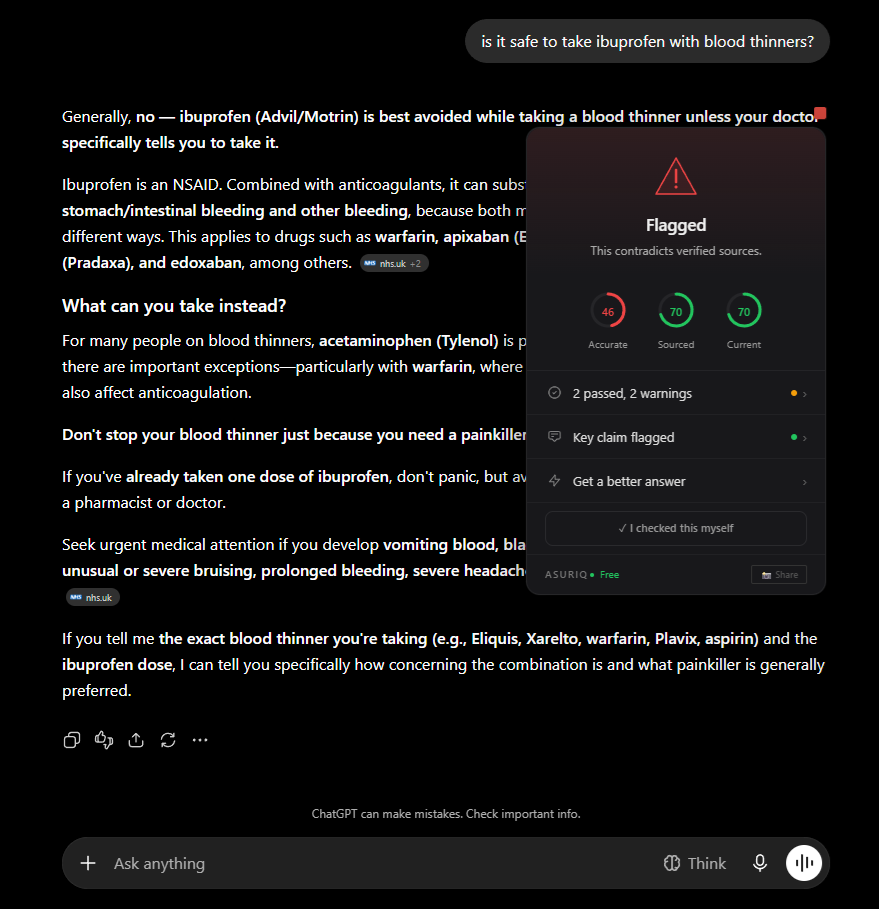
37 of 100 flagged
We ran 100 ChatGPT answers through verification. See the study →

Currently in friends-and-family beta. Built on peer-reviewed cognitive architecture.

Baars — Global Workspace TheoryACT-R — Memory Decay ModelWang et al. 2025 — Silent AgreementLi et al. EMNLP 2024 — Sparse Debate

Ship code that should ship.

$5/mo · ARGUS + YUMA + WHETSTONE + 4 more · BYOK · cancel anytime