Your AI doesn't just generate. It reasons.
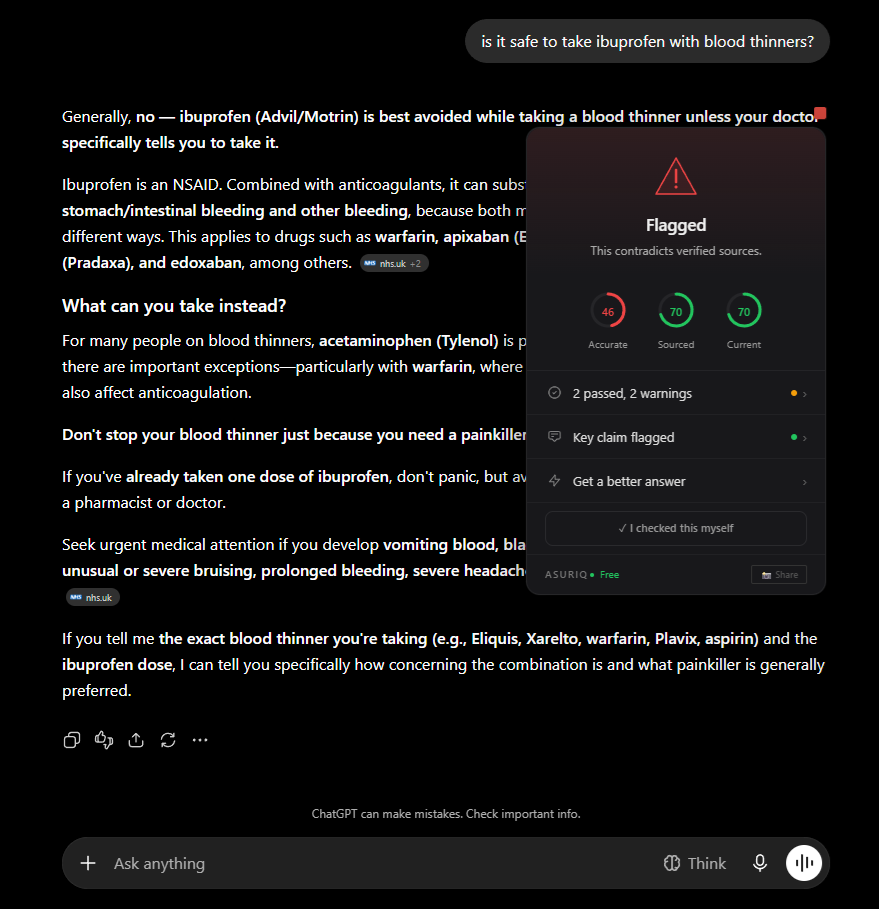
Same question. Same model. Completely different answer.
The Cognitive Stack gives your AI structured reasoning, modeled after real biological cognitive systems, that runs behind the scenes before it speaks.
You see the result. Not the process.
This is what your AI's output looks like after the Cognitive Stack processes it. The reasoning happens invisibly, inside the API call. You keep using ChatGPT, Claude, or whatever you use now. The answers get better.
Three steps. Five minutes.
curl -X POST https://consensus-production-6eeb.up.railway.app/api/v1/cognitive/confidence \\
  -H "Content-Type: application/json" \\
-d '{"text": "Your AI response here", "api_key": "YOUR_KEY"}'Don't have an AI key? The Chrome extension and custom GPT work without one for free features.
Need help getting a key? Step-by-step guides for every provider →
Reasoning runs on your own AI provider, through your key — the same architectural privacy as the rest of ASURIQ. We never operate a separate model to read your prompts, and the key is never stored. How this works everywhere on ASURIQ →
Modeled after biological cognition.
Your brain doesn't have one thinking mode. It has systems. Curiosity that pulls you toward gaps in what you know. An immune system that rejects bad information. Sleep that consolidates memories. Adversarial challenge that stress-tests beliefs before you commit.
We built all eleven.
Seven of these are reasoning tools you call directly through the API: confidence scoring, adversarial challenge, calibration, reflection, growth detection, and assertion routing. The other four (LOOM, brain.db, NIGHTSHIFT, TESSRYX) are infrastructure. They run continuously underneath, maintaining memory, consolidating knowledge, tracking provenance. You don't call them. They make everything else work.
They're multiplicative. WHETSTONE can't challenge effectively without TREG calibrating what "effectively" means. IMPRINT can't learn without brain.db to store what it learned. NIGHTSHIFT can't maintain memory it can't access. Remove any one system and the others degrade. The whole is exponentially greater than the sum.
"Can't I just write a better prompt?"
(agrees with itself)
The difference between a prompt and an architecture is the difference between asking someone to check their own homework and hiring an auditor. Your AI will always agree with itself. The Cognitive Stack runs genuinely independent systems with different instructions, different calibration data, and different failure modes.
One model thinks deeper. Multiple models think wider.
Single-model mode
Same model you use today. Deeper reasoning. Your existing AI gains structured thinking: confidence scoring, adversarial challenge, calibration, reflection, growth detection. All 7 tools running on your one provider.
Multi-model mode
Same 7 tools, but running across multiple providers. Cross-provider confidence scoring. WHETSTONE challenges from a genuinely different model. Calibration that catches provider-specific blind spots. Independent errors, compounding accuracy.
Start single-model. It's where most users begin. When you want cross-provider validation, where Claude challenges GPT's confidence, or DeepSeek catches blind spots that Gemini misses, add Routing and unlock multi-model mode. Note: some tools (Confidence, WHETSTONE, IMPRINT, ARGUS) require a mid-tier model. Without Routing, they won't fire on budget models. ASURIQ won't badge degraded output.
Start free. Add power when you need it.
Seven reasoning tools. Four infrastructure systems.
The seven reasoning tools are what you call. Each makes your AI smarter on its own. Together, they compound: confidence scoring means nothing without calibration, and calibration means nothing without adversarial challenge. Some tools require a mid-tier model or better. If your model is below the threshold, the tool explains why and offers Routing as the fix.
See every cognitive system and how they connect. The architecture at a glance. Always free, no key needed.
Not a single number. Three categories — is this correct, is it well-supported, is it current — with six evidence axes underneath. Shows you exactly WHERE the answer is strong and where it's weak.
Some questions deserve confident assertion. Some need investigation. Some need honest refusal. Your AI usually answers everything the same way. This picks the mode that matches the question.
Not "here's the other side." The strongest counter-argument a genuinely different mind can construct. Like stress-testing steel. What survives is stronger for having been tested.
Is that 80% confidence actually warranted? Calibrated against 15 documented cases where AI was confidently wrong. The system that catches overconfidence and institutional bias in training data.
After a session, your AI reviews what happened. What surprised it, what it should update, what tools would have helped. Those learnings feed directly into the next session. Neuroplasticity, implemented.
Most AI just answers your questions. PROMETHEUS spots the questions it SHOULD be asking but isn't. Detects capability gaps, proposes upgrades. Your AI doesn't just work. It gets better.
Same tools. Different brains. Better answers.
Every cognitive tool in the stack works with one model. But when you add Routing and connect multiple providers, those same tools gain a superpower: cross-provider validation. Your confidence score isn't one model's self-assessment anymore. It's three independent models evaluating the same claim.
Requires Routing. Multi-model Cognitive Stack needs Routing ($13/mo) to manage your provider keys and route queries across models. Learn about Routing →
Currently in friends-and-family beta. Built on peer-reviewed cognitive architecture.