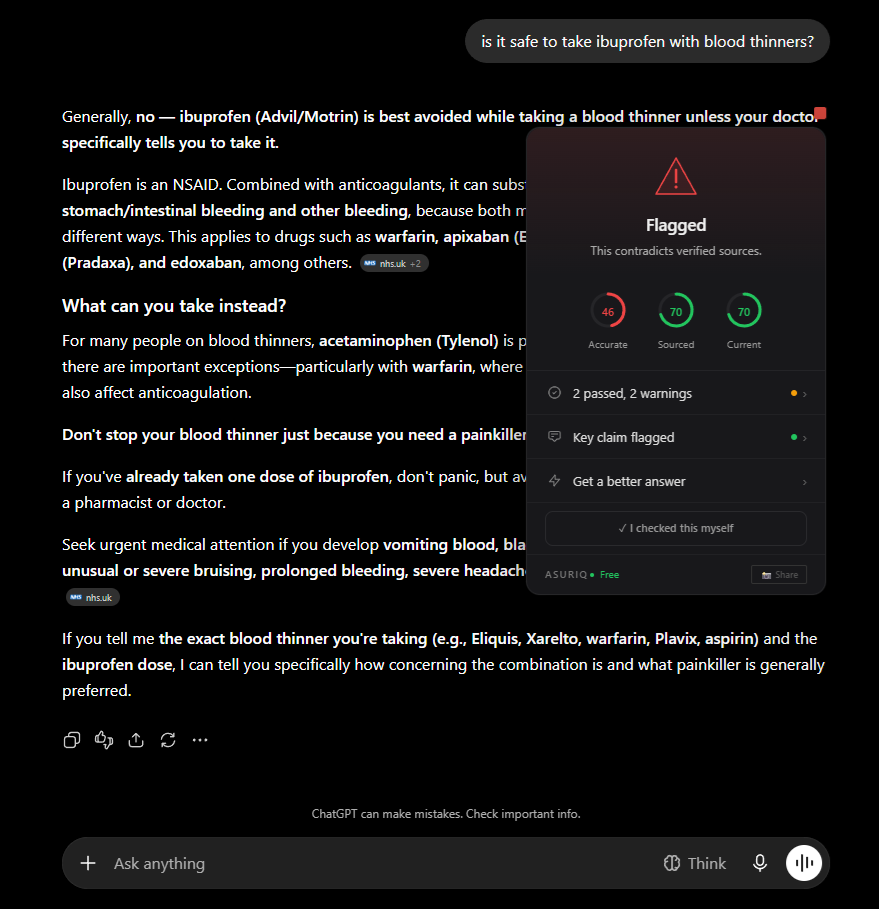
A grade on the source answers a different question than a check on the claim.
Rating a whole outlet, a whole model, or a whole publication measures how that source has performed on average. It says nothing about the one statement you’re actually deciding whether to trust. Claim-level verification checks that specific statement against sources and the public record, and returns a verdict scoped to it alone. These aren’t two ways of measuring the same thing — they’re answers to different questions, and only one of them tells you whether to trust what’s in front of you right now.
The grader and the graded can’t be the same party.
A provider that certifies its own answers is marking its own homework. That’s not a claim about anyone’s honesty or intent — it’s structural. Independence is what makes a grade mean anything at all; remove it, and the grade collapses into a claim about itself. ASURIQ has no stake in whether any given answer turns out to be right. It checks claims against public databases it doesn’t own and has no return on, not against its own products.
Same conflict, one layer over.
A platform that hosts reviews and also vouches for their authenticity is grading itself again, just wearing a different hat. The reviews live on its own site, feed its own conversion numbers, and the certification comes from the party with the most to gain from a favorable one. Independent verification closes this gap the same way it closes the first one: a party with nothing riding on the outcome checking the claim on its own terms. The logic is identical whether the claim under review is a sentence in an AI answer or a five-star rating on a product listing.
Published, versioned, and checkable — not asserted.
This isn’t a claim you have to take on faith. The scoring method behind every ASURIQ verdict — how evidence is weighted, how independence is scored, what the system refuses to measure — is published and versioned on the methodology page. When a scored party disputes a verdict, the answer is that page: here is the standard, here are the categories, here is the record behind this specific score.