Shop

Reviews, checked the way evidence should be.

Fake reviews are a documented problem: paid five-star blocks, bot-written testimonials, and listings where every “verified purchase” traces back to the same handful of accounts. Shop runs the same evidence-and-independence engine behind ASURIQ on reviews and listings themselves — not just on what an AI says about them.

What it checks

Not sentiment. Evidence.

Shop doesn’t score how positive a review sounds. It checks whether the evidence behind a listing’s reputation holds up — and discloses plainly when it doesn’t.

Review fingerprinting
SCRVNR-style writing-pattern analysis flags review clusters that read like one author, not many — the same fingerprinting technique built to score generated text in milliseconds, pointed at listings instead of chat.
Ownership, not just star count
A product with 4,000 five-star reviews from 4,000 independent accounts is a different situation from the same count funneled through one seller network. Independence ships as fact, the same way it does everywhere else on ASURIQ.
Marketplace certification
A listing that checks out can carry a certificate — the same resolving /v/[id] record every other ASURIQ verdict produces. A fake cannot resolve one.
FTC Consumer Reviews Rule in active enforcement · penalties up to $53,088 per violation · no daily cap on checks
Review fingerprinting

One author, many names.

SCRVNR fingerprinting is writing-pattern analysis — the same technique that scores generated text in milliseconds elsewhere in the ASURIQ family, pointed at reviews and listings instead of chat responses. It doesn’t need an account to admit a connection. The writing itself carries the signal.

Writing cadence
Sentence length, punctuation rhythm, and paragraph-break patterns repeated across reviews that claim to be unrelated people.
Account clustering
Groups of accounts that post in the same narrow windows, on the same listings, with no other overlapping activity — a pattern real independent shoppers don't produce.
Timing concentration
A review count that arrives in bursts rather than the steady trickle a genuine customer base produces over time.
Cross-listing correlation
The same writing fingerprint reappearing on different products or different sellers — one voice, many storefronts.
What a flagged cluster looks like

Dozens of five-star reviews, posted under distinct account names, spread across a narrow window. Strip the names away and the writing collapses into a handful of voices: the same three phrases, the same sentence shape, the same place the praise turns to a specific product claim. No individual review looks wrong on its own — the pattern only shows up in aggregate, which is exactly what fingerprinting is built to surface.

Shop flags what the evidence shows and discloses why — it never hides, collapses, or removes a listing or its reviews. An auditor annotates; it doesn’t erase. And it scores the pattern, never the retailer: fingerprinting describes review clusters structurally, and doesn’t characterize any specific named marketplace, seller, or product as fraudulent.

Why it matters now

Fake reviews carry real legal stakes.

Federal rules now prohibit fake and incentivized reviews, and the FTC’s Consumer Reviews Rule is in active enforcement — penalties run up to $53,088 per violation. Review authenticity has moved from a reputational nice-to-have to a compliance question for marketplaces and brands with real regulatory exposure attached.

For marketplaces
Hosting fake or incentivized reviews at scale is now an enforcement target, not just a trust problem. Independent, structural evidence of review authenticity is the record a marketplace wants on hand before that question gets asked.
For brands
A brand whose own listings check out — and can show it — has an answer ready for customers, retail partners, and regulators alike. A clean fingerprint is evidence, not a promise.
Marketplace certification

The listing that can prove it.

This is Shop’s B2B line: marketplace and brand review-authenticity certification. A marketplace can’t credibly certify its own reviews — that’s the same auditor argument behind every ASURIQ verdict. An independent certificate can.

1
Submit for audit
A marketplace or brand submits a catalog or listing set. Shop runs the same fingerprinting and ownership-grouping pass used everywhere else on ASURIQ.
2
Evidence, not a promise
The audit produces a real record: review count, independent authorship clusters, and any flagged patterns — the same evidence structure behind a /v/[id] certificate.
3
Certificate mints
A listing set that checks out gets a certificate at a resolving asuriq.dev/v/[id] URL. A fake listing set cannot produce one — there's no evidence to certify.
4
Embed it
The certificate embeds on the marketplace's or brand's own site: the badge plus the verdict stated in words, linking back to the full record. Anyone can check it.
yourmarketplace.com/listing/…
Product listing
★★★★★ 1,204 reviews
ASURIQ: verified
ASURIQ Verified
1,204 reviews · 187 independent origins

Example embed — illustrative, not a live certificate. A real certificate always links the full record at asuriq.dev/v/[id].

See it working

The verification engine, running live.

Watch a real claim get checked against 269 databases in real time. The same engine that powers Shop.
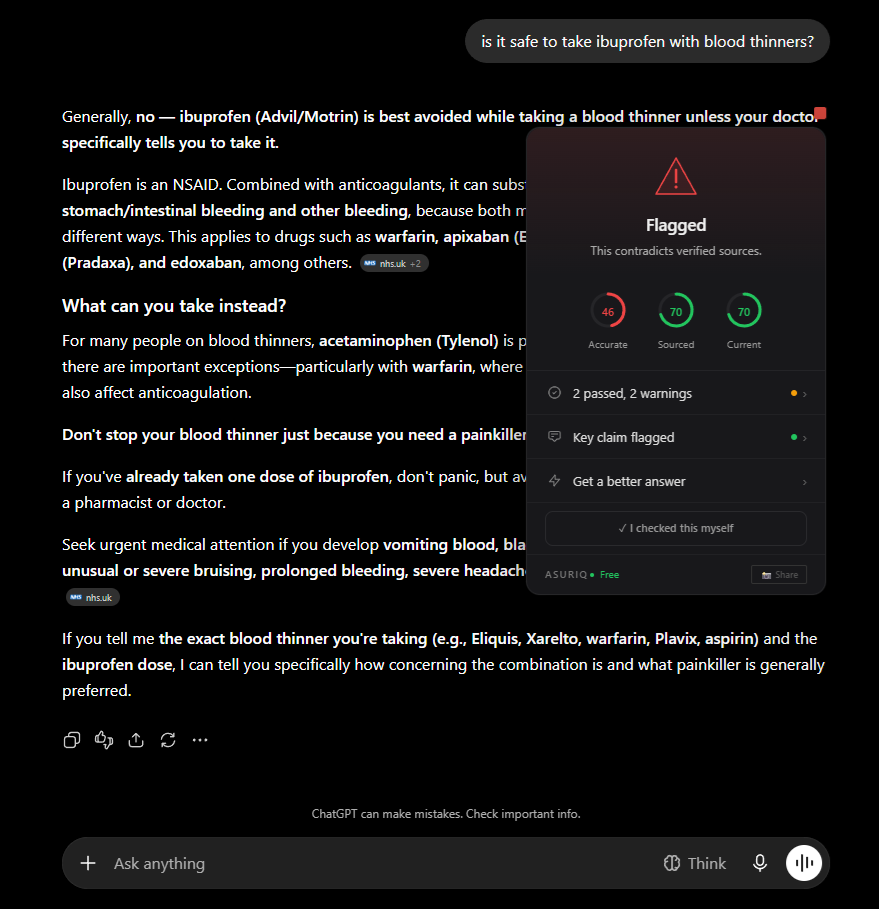
ASURIQ verification engine running on a real claim
Your data stays yours
Prompts stay with your provider. We see analysis metadata only.
Keys never stored
One-way hash for authentication. Your credentials pass through. Never persist.
~2 second responses
Single-model cognitive tools return in about 2 seconds.
37 of 100 flagged
We ran 100 ChatGPT answers through verification. See the study →

Currently in friends-and-family beta. Built on peer-reviewed cognitive architecture.

Baars — Global Workspace TheoryACT-R — Memory Decay ModelWang et al. 2025 — Silent AgreementLi et al. EMNLP 2024 — Sparse Debate

Know before you buy.

Friends-and-family beta · get access, try it on a real listing