News

The claim, checked. The ownership, disclosed.

Two outlets covering the same story isn’t two confirmations if they share an owner. News runs claim-level verification on published articles the same way Verify runs it on AI answers, and adds what a claim alone can’t show you: who owns the source, and how many of your “multiple sources” are actually one.

What it checks

Corroboration, not just agreement.

Claim-level checks
The same evidence-and-independence engine behind Verify, run against published articles — checking, weighting, and certifying claims rather than adjudicating the story.
Ownership clustering
Maps which outlets share a parent company, a funding source, or an origin chain — so "four sources agree" and "four sources under one owner agree" stop looking identical.
Source-side, never claim-side
News ships ownership and origin-chain depth as fact. It does not score a story's slant or promote a claim based on how it's framed — that judgment is not ASURIQ’s to make.
1. Claim-level verification

Certifying the claim, never adjudicating the story.

News runs the identical evidence-and-independence engine behind Verify against articles that are already published, rather than answers an AI just generated. The claim is the unit of verification — not the outlet, not the byline, not the headline, and not “the story” as a whole.

Check
Each factual claim in an article — a figure, a vote count, a date, a quote — is looked up against the databases relevant to its domain, exactly as it would be if the same sentence had come out of an AI chat.
Weight
The same three-category engine that scores an AI answer scores the article's claim: is this correct, is it well-supported, and is it current.
Certify
Each claim resolves to its own permanent, linkable certificate — the evidence, the scores, the verdict stated in words.

An article can carry ten claims and ten different verdicts — some verified, some split, some pending because the story broke an hour ago. News reports each of those separately. It never rolls them up into a single grade for the piece, the byline, or the outlet — full axis definitions and the certificate format are on the methodology page.

2. Ownership clustering

Four sources. Three independent voices.

Before corroboration is counted, sources are grouped by common owner or funder — so coverage that looks like broad agreement can be shown for what it actually is: fewer independent voices than the byline count suggests.

ASURIQ: verifiedVerified

“The regional transit authority approved a $340 million rail extension Tuesday, its largest capital project in a decade.”

Evidence
Transit authority meeting minutes
Regional Transit Authority (public record)
Board approved the $340M extension by a 5-2 vote.
Jul 14
Harborview Daily
Meridian Media Group
Confirms the 5-2 vote, citing the authority's own filing.
Jul 14
Metro Ledger
Meridian Media Group
Reports the same vote total, citing Harborview Daily's coverage.
Jul 15
Statehouse Wire Service
Independently confirms the vote via its own agency contact.
Jul 15
Independence
1 source shares an owner with another source on this record — counted once in the group total, not 4 times.

Harborview Daily and Metro Ledger share a parent company, so they count as one voice, not two. Three independent origins behind the same figure — the public record and two outlets that reached it separately — is real corroboration, not four bylines repeating the first report.

The same ownership-clustering math that scores a claim’s sources scores ASURIQ’s own evidence base first — see independence scoring on the methodology page for the full mechanics: ownership clustering, origin-chain depth, and beneficiary concentration.

3. Source-side, never claim-side

We measure outcomes, not motives.

News discloses ownership, funding, and origin-chain depth as fact. It never scores a story’s slant, bias, or truthfulness beyond the evidence cited, and it never treats a claim as more or less credible because of who supports or opposes it.

We disclose
Who owns and who funds a source
Whether corroborating sources share an owner
Origin-chain depth — how many hops separate a report from the original account
Corroboration density, counted by independent voice, not by byline
We never
Score a story's bias, slant, or editorial framing
Promote or demote a claim based on how "captured" its opposition looks
Treat low corroboration as evidence of suppression
Characterise a source's honesty, intent, or motive

“This story’s four corroborating sources sit under two ownership groups” is a fact nobody can contest. “Mainstream coverage disagrees with this claim, but that’s what a captured press would say” is exactly the kind of claim-side reasoning News refuses to ship. Absence of independent corroboration is reported as a coverage fact about the sources, never as suppression, and never as evidence that an unconfirmed claim is true.
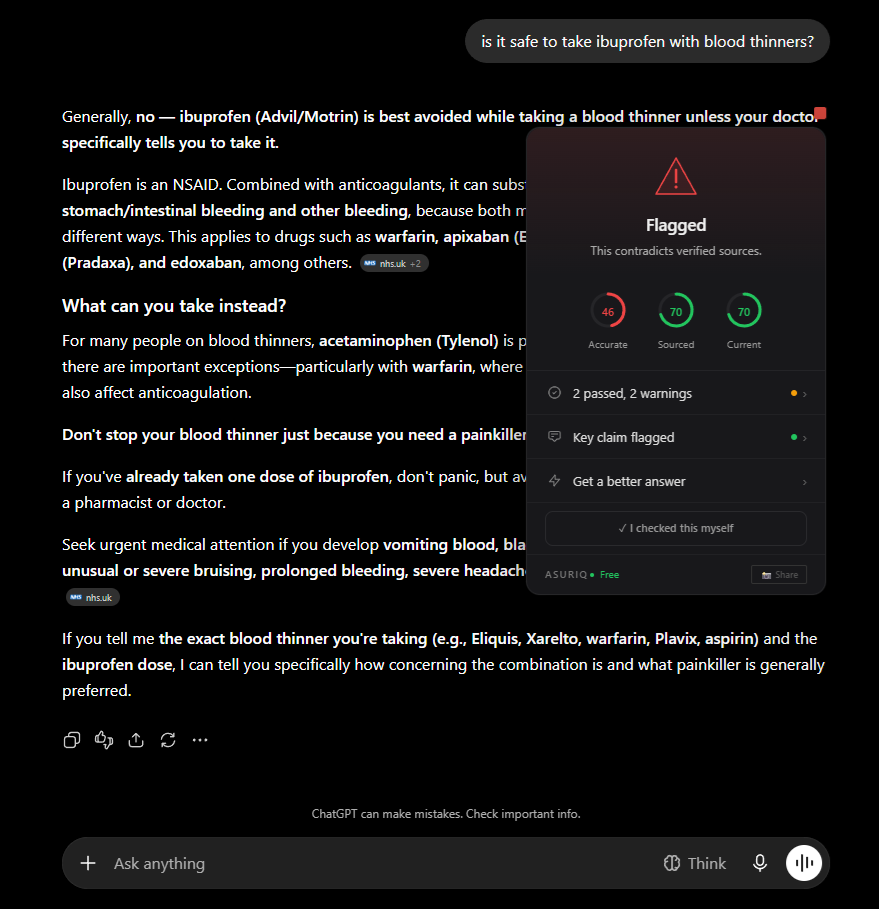
See it working

The verification engine, running live.

Watch a real claim get checked against 269 databases in real time. The same engine that powers News.

ASURIQ verification engine running on a real claim
Your data stays yours
Prompts stay with your provider. We see analysis metadata only.
Keys never stored
One-way hash for authentication. Your credentials pass through. Never persist.
~2 second responses
Single-model cognitive tools return in about 2 seconds.
37 of 100 flagged
We ran 100 ChatGPT answers through verification. See the study →

Currently in friends-and-family beta. Built on peer-reviewed cognitive architecture.

Baars — Global Workspace TheoryACT-R — Memory Decay ModelWang et al. 2025 — Silent AgreementLi et al. EMNLP 2024 — Sparse Debate

See who's really behind the story.

Friends-and-family beta · get access, try it on a real article