Memory

Your AI forgets everything. Every single time.

Yesterday you spent 20 minutes explaining your project, your tech stack, your constraints. Today you open a new conversation and your AI has no idea who you are.

Memory gives your AI persistent knowledge that survives between sessions. It remembers what you told it, what it learned, and what matters to you. Not a chat log. A knowledge graph that strengthens useful connections and lets unused ones fade. The way biological memory actually works.

Without Memory

Monday: " I'm building a Next.js app with Supabase auth and pgvector..."

Tuesday: " I'm building a Next.js app with Supabase auth and pgvector..."

Wednesday: " I'm building a Next.js app with Supabase auth and pgvector..."

With Memory

Monday: " I'm building a Next.js app with Supabase auth..."

Memory saved: project stack, auth approach, search architecture, deploy target

Tuesday: " How should I handle the embedding pipeline?"

Already knows your stack. Answers in context. No repetition.

Add Memory · from $5/moUp to 10,000 stored memories per user · cross-platform · cancel anytime
Two options

Pick the memory that fits.

Memory Local
$5/mo

Runs entirely in your browser. IndexedDB storage, keyword search, service worker pruning. Your data never leaves your device.

Privacy-first: nothing leaves your browser
Keyword search and basic similarity
Service worker maintenance
Single-device only
No account infrastructure needed
Memory Hosted
$9/mo

Server-side memory with full cognitive architecture. Hybrid recall, entity graph, and 13-pass NIGHTSHIFT autonomous maintenance while you sleep.

Hybrid recall: meaning + keyword search combined
Knowledge graph with automatic clustering
13-pass NIGHTSHIFT maintenance
Cross-device sync
Up to 10,000 memories

Everything below this point describes Memory Hosted. Memory Local is the privacy-first alternative with the same core concept: your AI remembers.

Up to 10,000 stored memories · searches by meaning, not just keywords · 13 autonomous maintenance passes · memories fade naturally like yours do

The connections you didn't know you needed.

Memory doesn't just store what you said. It builds a graph of relationships between everything it knows about you. And sometimes those connections surface at exactly the right moment.

You're debugging a database connection issue
Three weeks ago you mentioned switching from Prisma to Drizzle. Memory surfaces the migration context. The connection issue might be related to the ORM change, not the database itself.
The moment your AI connects dots you forgot you drew
You ask about React state management
Memory knows you tried Zustand last month, hit performance issues with large stores, and preferred the simplicity of Jotai's atomic model. It doesn't recommend Zustand again.
An AI that learns from your experience, not just its training data
You're writing a pitch deck for investors
Memory recalls your product positioning from a conversation two months ago, your competitor analysis from last week, and the specific metrics you told it to track. It assembles context from across your history.
The feeling of working with someone who was in all the meetings
You mention you're tired and it's late
Memory knows your last 3 late-night coding sessions led to bugs you had to fix the next morning. It suggests saving the complex refactor for tomorrow and offers quick wins instead.
An AI that knows your patterns, not just your projects

It compounds. Day 1, Memory stores your project context. Day 30, it knows your preferences, your tech stack, your decision patterns, your working style. Day 90, your AI has genuine institutional knowledge about you and your work.

The longer you use it, the less you repeat yourself. The less you repeat yourself, the more you get done. And every now and then, it surfaces a connection that makes you think: " I forgot I told you that."

The architecture

Not a chat log. A knowledge graph.

Chat history stores everything. Memory stores what matters. An observation is a single piece of knowledge: a fact, a preference, a decision, a pattern. Up to 10,000 of them, organized into an entity graph with weighted connections.

Smart storage
Every memory is stored so it can be found by meaning, not just keywords. "That conversation about auth" finds auth-related memories even if you never said the word.
Hybrid recall
Two search engines run simultaneously. One finds memories by meaning. The other finds exact keyword matches. Results are merged and ranked together. Better than either alone.
Knowledge graph
Memories connect to entities: your project, your tools, your preferences form nodes. Connections between them strengthen with use. Ask about your project and you get the whole cluster of related knowledge.
Quality scoring
Every memory gets a quality score (0-1). High-quality memories surface first. Low-quality memories decay faster. The system learns what's valuable from your actual usage patterns.
Natural decay
Memories that go unaccessed lose quality over time. Memories that get recalled strengthen. Based on how human memory actually works — things you use stay sharp, things you don't fade naturally.
NIGHTSHIFT
13 autonomous passes run while you sleep. Prune stale memories. Consolidate fragments. Detect drift. Strengthen accessed memories. The same consolidation cycle your brain runs during sleep.
NIGHTSHIFT

13 maintenance passes. While you sleep.

Your brain consolidates memories during sleep: strengthening important connections, pruning unused ones, integrating new knowledge with old. NIGHTSHIFT does the same for your AI. Every night, 13 autonomous passes maintain the health and accuracy of your knowledge graph.

1
Stale pruning
Marks memories that haven't been accessed and have low quality
2
Consolidation
Merges fragmented memories about the same entity into coherent summaries
3
Edge strengthening
Reinforces connections between frequently co-accessed memories
4
Edge pruning
Weakens and removes connections that no longer reflect real relationships
5
Drift detection
Identifies when your preferences or patterns have shifted since last check
6
Quality recalibration
Adjusts quality scores based on actual recall usefulness over time
7
Entity resolution
Detects when different names refer to the same entity and merges them
8
Cluster discovery
Finds natural clusters of related entities in your knowledge graph
9
Signal analysis
Tracks health metrics across your memory graph and flags anomalies
10
Contradiction detection
Finds memories that conflict with each other and flags for resolution
11
Temporal coherence
Ensures time-sensitive memories are appropriately weighted by recency
12
Source quality audit
Evaluates which sources produce the most useful memories
13
Graph compaction
Reduces graph complexity without losing information density
The endpoints

Five endpoints. Complete memory.

POST
/memory/remember
Remember
Save a memory with automatic embedding. Attached to entities for graph structure. One API call.
POST
/memory/recall
Recall
Hybrid search. Meaning-based and keyword matching combined and ranked together. Returns the most relevant memories ranked by quality.
GET
/memory/graph
Graph
Your entity graph. Nodes are entities, edges are relationships, weighted by interaction frequency. See how your knowledge connects.
GET
/memory/stats
Stats
Memory health. Total memories, stale count, average quality, entity count, last NIGHTSHIFT run.
DELETE
/memory/:id
Delete
Remove a memory. Cascades to edges. You own your data.
What this replaces
Cross-device note sync (Obsidian Sync, Notion)$10–15/mo
AI context management tools$10–20/mo
$20–35/mo replaced by $9/mo
See the verification engine
ASURIQ verification — click to watch
Your data stays yours
Prompts stay with your provider. We see analysis metadata only.
Keys never stored
One-way hash for authentication. Your credentials pass through. Never persist.
~2 second responses
Single-model cognitive tools return in about 2 seconds.
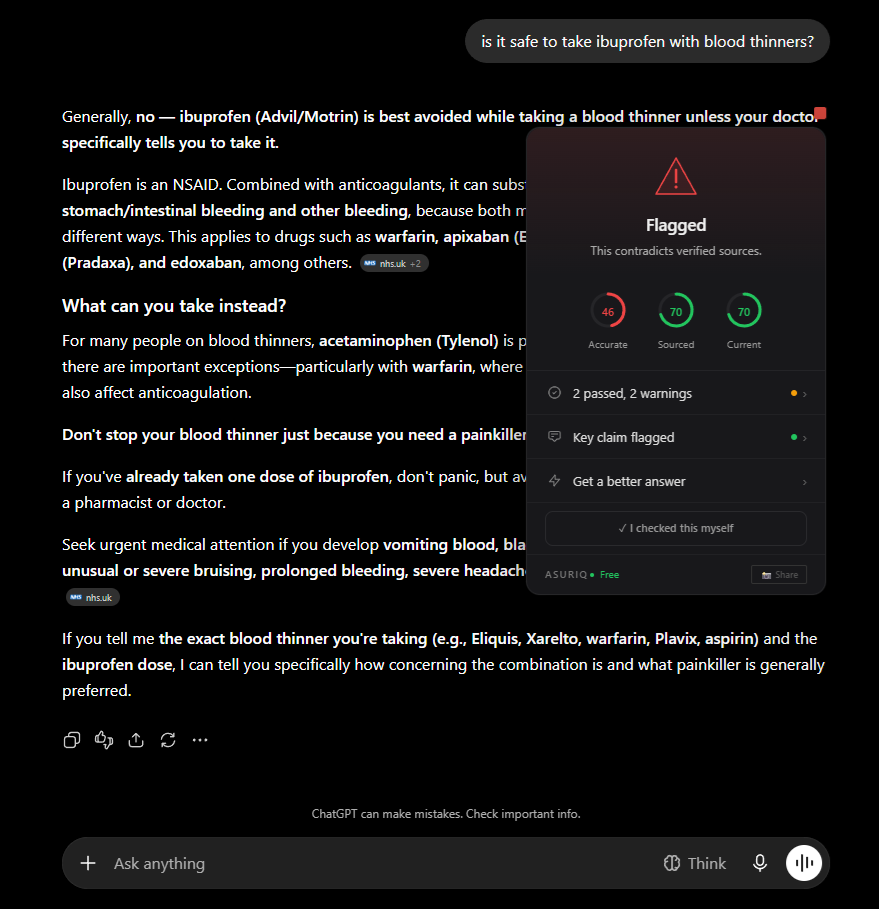
37 of 100 flagged
We ran 100 ChatGPT answers through verification. See the study →

Currently in friends-and-family beta. Built on peer-reviewed cognitive architecture.

Baars — Global Workspace TheoryACT-R — Memory Decay ModelWang et al. 2025 — Silent AgreementLi et al. EMNLP 2024 — Sparse Debate

Give your AI a memory.

Local $5/mo · Hosted $9/mo · works with any AI provider · cancel anytime